Conducting Necessary Transition Assessments

2
empty
Includes Coaching
Beginning in September 2026, the following courses will be discontinued:
• Writing Appropriate Measurable Postsecondary Goals
• Conducting Necessary Transition Assessments
• Coordinated Set of Activities
A new course series titled “Texas Transition Learning Series: Mapping the Path to Postsecondary Success" is being developed to support school systems to review and strengthen the implementation of effective transition planning practices. More information will be available on this page as courses in the series are published.
We appreciate your patience and understanding during this time.
Related Resources
Transition, Evaluation, ARD/IEP Supports
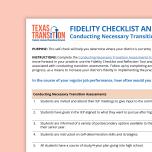
Fidelity Checklist and Reflection Tool: Conducting Necessary Transition Assessments
This self-check will help you determine where your district is currently performing in regard to conducting transition assessments
View Tool/Template